The short answer
Replace a furnace when repairs keep piling up, safety issues appear, or the unit no longer heats the house evenly. We size the new system to your home, check venting and ducts, and explain gas and heat pump options before you choose.
Replacing a furnace is one of the few home projects where the right answer depends heavily on timing. A unit that quits on a cold January night forces a quick decision; one that is merely getting tired gives you room to compare options calmly. ExpertFlow HVAC Repair Service installs gas furnaces and electric alternatives for homeowners across Los Altos and the surrounding Santa Clara County communities, including Los Altos Hills, Mountain View, Palo Alto, Sunnyvale and Cupertino. Our approach is simple: measure the house, inspect what is already there, explain the trade-offs in plain language and put everything in writing before a single panel comes off. Plenty of local homes still run furnaces tucked into hall closets, garages or crawlspaces, sometimes connected to ductwork that has been patched over decades. A new furnace will only perform as well as the system around it, so installation planning covers the venting, gas line, return air and ducts as well as the box itself.
Clues that a replacement is coming
Furnaces rarely fail without warning. Most give months of hints, and recognizing them early lets you plan the project instead of scrambling for it.
- Repair visits have become an every-winter habit, often for different parts each time
- Some rooms stay chilly while the hallway near the thermostat feels fine
- The burner flame looks yellow or lazy instead of crisp blue
- You notice soot near the unit, a persistent odor or rust on the cabinet
- A carbon monoxide alarm has gone off, or a technician found a cracked heat exchanger
- Gas bills climb even though your thermostat habits have not changed
- The furnace is loud on startup, with booming, rattling or a long screech from the blower
Our pre-installation inspection
Swapping a new furnace into the exact footprint of the old one is tempting, but it often repeats the old system's mistakes. We start with a load calculation that accounts for the home's size, insulation, window area and orientation. Many older furnaces in this area were sized generously, and a correctly matched replacement can be smaller, quieter and more comfortable.
Next we look closely at the supporting pieces. The flue or vent has to suit the new furnace's efficiency level; high-efficiency condensing models vent through plastic pipe and need a condensate drain, while standard-efficiency units use a metal flue. We check the gas supply line, the electrical connection, the size of the return air path and the condition of the ductwork. Leaky or crushed ducts in an attic or crawlspace can undo much of what a new furnace offers, so we point out any problems we see and explain what fixing them would involve.
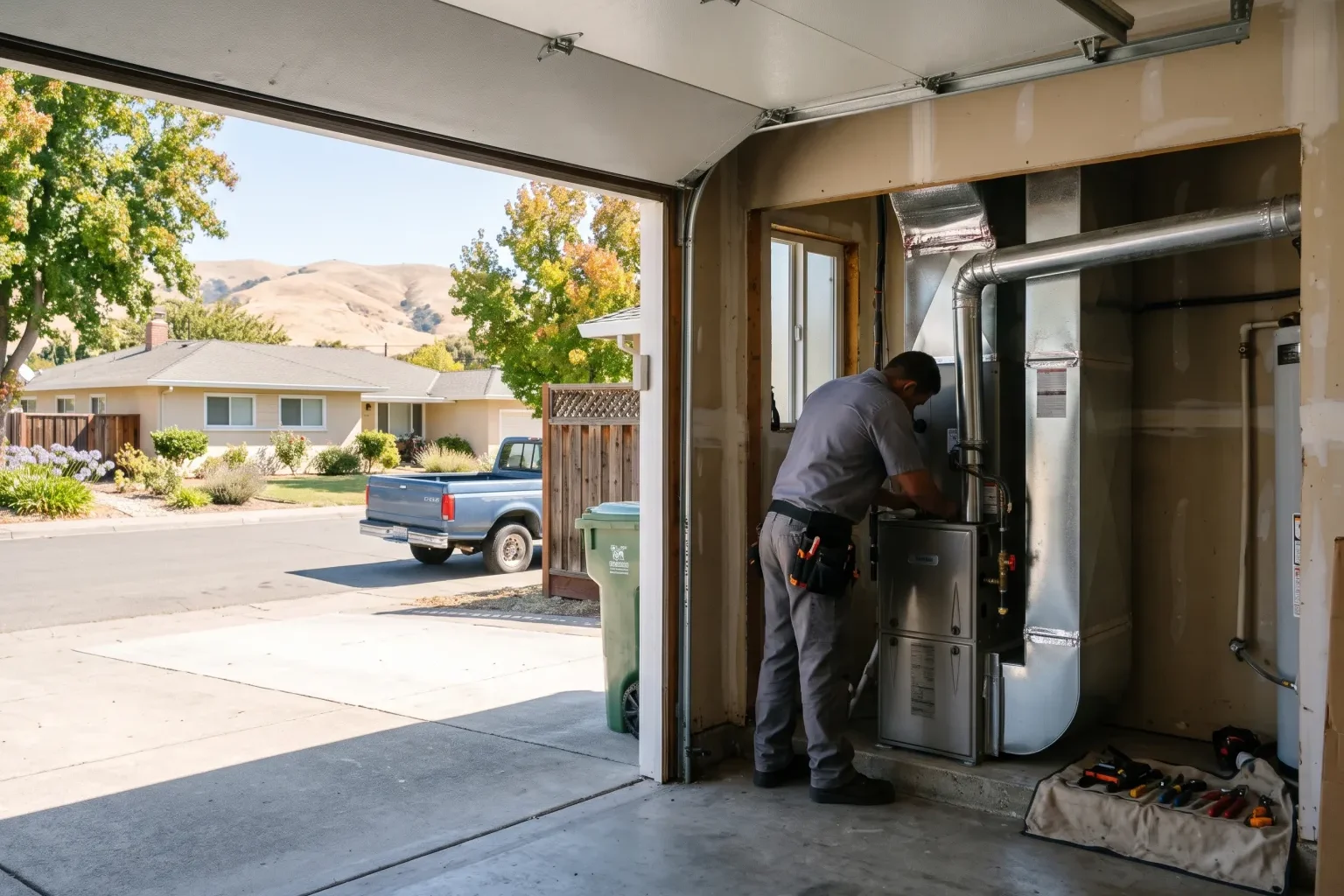
Finally, we confirm clearances. Closet installs need adequate combustion air and service access, and garage installs have their own placement requirements. These details shape which models will actually fit.
Repair, replace with gas, or switch to a heat pump
If your furnace is in reasonable shape and the problem is a single failed part, a repair is usually the better value, and we will say so. A replacement conversation makes sense when the heat exchanger is compromised, when the unit is near the end of a normal service life and needs an expensive component, or when comfort problems trace back to an undersized or badly matched system.
When replacement is the answer, homeowners here have two main paths. A new gas furnace keeps your current fuel and can pair with an existing air conditioner. A heat pump, either ducted through your existing system or as part of a hybrid setup, handles both heating and cooling with electricity. Rules are part of this choice. The Bay Area Air District's Rule 9-4 sets a zero-NOx standard for natural gas furnaces manufactured starting in 2029, which effectively steers future furnace replacements toward heat pumps. It does not require anyone to remove a working furnace; it comes into play only at failure or replacement.
We will lay out both directions, explain how each fits your house and your plans for it, and let you choose without pressure.
Factors that move the installation estimate
Each furnace estimate is built from the specifics of the home. The main variables are the equipment type and efficiency rating, single-stage versus two-stage or variable-speed operation, and whether the new unit fits in the existing location. Venting changes, such as converting from a metal flue to PVC for a condensing furnace, add work. So do gas line modifications, new electrical circuits, condensate drain routing and any ductwork sealing or replacement you choose to include.
Access matters too. A furnace in an open garage is simpler to replace than one in a tight attic or low crawlspace. Permit and inspection requirements vary by city. If you are considering a heat pump instead, check BayREN and your clean energy provider for current incentives; those programs change by funding cycle, so we verify the offer before it appears in your quote. The federal 25C credit is no longer available for systems installed after 2025.
What happens on installation day
After you approve the written proposal, we file the permit and book a date. The crew arrives, lays floor protection along the work path and shuts off gas and power to the old unit. We disconnect and remove the old furnace, set the new one, connect the gas line, venting, electrical and ductwork transitions, and install a new filter rack if needed.
Startup is not a quick flip of the switch. We test for gas leaks, measure combustion and temperature rise, check static pressure in the ducts, verify the blower setting and confirm the safety controls work. Then we walk you through the thermostat, show you where the filter goes and explain basic care. The city inspector signs off on the permit at a follow-up visit, and the old equipment leaves with us.