The short answer
If your AC blows warm air, short-cycles, freezes up, leaks water or trips its breaker, it needs a diagnostic visit. We test refrigerant, electrical parts, airflow and drainage, then explain whether a repair or replacement makes more sense for your system.
Cooling problems in this part of the Peninsula rarely announce themselves in May. They show up on the first stretch of hot afternoons, when a system that sat idle all winter suddenly has to run for hours. ExpertFlow repairs central air conditioners and heat pumps in cooling mode for homes in Los Altos, Los Altos Hills, Mountain View, Palo Alto, Cupertino and surrounding towns. This page covers the warning signs worth acting on, the checks our technicians run, how we weigh a repair against a replacement, and what shapes the final bill.
Symptoms That Call for a Technician
Some issues are easy to fix yourself, like a dead thermostat battery or a filter caked with dust. Others point to a mechanical or electrical fault that will get worse with continued running. Shut the system off and book a visit if you notice any of the following.
- Air from the vents feels barely cooler than the room, even after a long run
- The outdoor unit hums but the fan blade does not spin
- Ice forms on the copper line at the outdoor unit or on the indoor coil
- Water pools around the furnace or air handler, or drips from an attic ceiling
- The system starts and stops every few minutes instead of running steady cycles
- A burning, electrical smell appears when the compressor kicks on
- The breaker for the condenser trips repeatedly
- Rooms at the far end of the house stay warm while the hallway is cold
Quick Checks Before You Book
A few minutes of looking can save you a visit, or at least give our technician a head start. Confirm the thermostat is set to cool, the setpoint is below room temperature and the display is not blank. Check the breaker panel for a tripped switch labeled for the condenser or air handler, and look for a disconnect box near the outdoor unit that may have been pulled or switched off by a gardener.
Pull the filter and hold it to a light. If you cannot see through it, replace it and give the system an hour. Glance at the outdoor unit as well: grass clippings, leaves and plants pressed against the coil can starve it of air. If everything looks normal and the cooling is still weak, leave the system off and let us take it from there. Note what you saw, since details like a clicking sound or an error code help the diagnosis move faster.
Inside the Diagnostic: What Gets Tested
A real diagnosis follows the cooling cycle from the thermostat to the outdoor unit and back through the ducts. Our technician starts by confirming the thermostat is calling correctly and that low-voltage wiring reaches both the indoor and outdoor equipment.
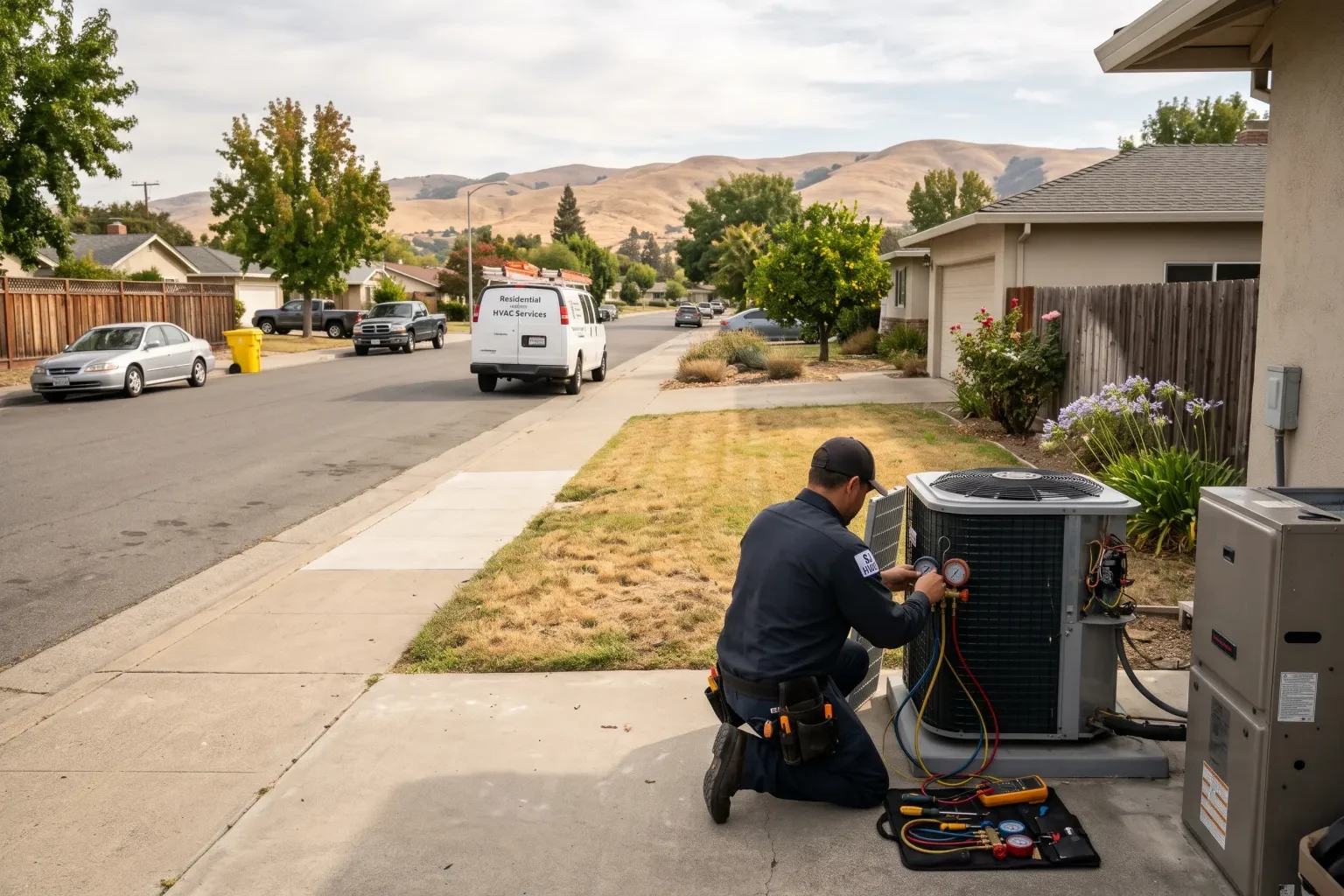
At the condenser, we measure voltage and amperage on the compressor and fan motor, test the run capacitor against its rated value and inspect the contactor for pitted or burned points. Capacitors and contactors are among the most frequent failures, especially after a hot spell, and they are inexpensive to confirm with a meter.
Refrigerant readings come next. Suction and liquid pressures, along with superheat or subcooling, tell us whether the charge is right and whether a restriction or leak is likely. If the charge is low, we look for the leak instead of simply topping it off, since adding refrigerant to a leaking system only postpones the next call.
Indoors, we check the evaporator coil, blower speed, filter and static pressure. A coil coated in dust or a blower running too slow can freeze a system that is otherwise healthy. Finally, we flush or test the condensate drain and safety switch, a common source of attic leaks in local homes.
Fix It or Replace It?
Most air conditioner problems are worth repairing. A failed capacitor, a clogged drain, a worn contactor or a bad fan motor can all be corrected, and the system returns to normal service. The decision becomes harder when the compressor fails, when the indoor coil leaks, or when an older system uses a refrigerant that is no longer produced for new equipment.
We look at a few factors together: the age and condition of the whole system, how often it has needed repairs, whether the cooling capacity ever matched the house, and what a major repair would represent relative to the system's remaining life. If a replacement is the more sensible choice, we will also talk through a heat pump, which provides both cooling and heating and fits where the Bay Area is heading on gas furnace replacements. Nothing requires you to replace working equipment, so the timing is yours.
What Drives the Cost of a Repair
We give you a specific quote after diagnosis, but it helps to know why two AC repairs can differ so much.
- The part involved: a capacitor or contactor sits at the simple end, a compressor or coil at the other
- Refrigerant type, and whether a leak has to be found and sealed first
- Access: equipment in a tight attic or crawlspace takes longer than a garage unit
- Whether the brand uses proprietary controls or parts that must be ordered
- Related damage, such as a ceiling stain from a drain that overflowed
How a Repair Visit Unfolds
When you schedule, tell us what you are hearing, seeing or feeling, and anything the thermostat displays. We arrive within the booked window, ask a few follow-up questions and get to work on the testing described above.
Before touching anything beyond the diagnosis, the technician explains the findings, shows readings or photos and lays out the repair choices. With your approval, common parts are often replaced the same day. If something must be ordered, we tell you how long it should take and set the return trip. Afterward, we run the system through a full cycle and confirm temperatures at the supply registers so you know the fix worked.
Older homes in Los Altos and Palo Alto sometimes have the air handler in a low crawlspace or a cramped attic. If yours does, mention it when booking so we can plan time for access and bring the right lighting and protection for the work area.